Generate targeted cover letters that get you noticed
Add your resume and the job description, and get a letter built from your real experience in seconds. Two free letters a day, with no account.
1. Your resume
Two free letters a day, no account needed. Nothing you add here is saved.
What is an AI cover letter generator?
Four-Leaf is an AI-powered cover letter generator that creates targeted, role-specific cover letters by analyzing both the job description and the user's resume.
Rather than producing generic template-based letters, Four-Leaf identifies the experience and skills most relevant to each specific position and crafts professional prose that explains why the candidate is a strong fit. Each generated cover letter references specific requirements from the job posting, maintains a professional tone, and avoids the formulaic language that hiring managers associate with mass applications.
Two letters a day are free here with no account. Account holders write unlimited letters and download them as formatted PDFs.
The tool is part of Four-Leaf's AI job search assistant built around you, which also includes AI mock interviews, resume tailoring, salary negotiation coaching, email drafting, job search, and LinkedIn optimization. Four-Leaf is available as a $5 / 5-day pass for one upcoming interview or $20/month Pro for an ongoing search, both with a 3-day free trial and no credit card required.
Get started in three easy steps.
Share your background
Four-Leaf already knows your experience from your resume. It uses your skills, achievements, and career history as the foundation.
Add the job details
Paste the job description or URL. The AI identifies what the employer values most and which of your experiences are most relevant.
Tighten it in the chat
Ask Clover to cut a paragraph or change the emphasis. It proposes the edit inline and you apply it in one click, then download as DOCX or PDF.
Built for candidates who want every edge.
Personalized to each role
Every letter is unique, written specifically for the job and company you're applying to. No generic templates.
Built from your experience
The AI pulls from your actual resume and achievements, so every claim in the letter is grounded in truth.
Professional tone
Get the right balance of enthusiasm and professionalism. The AI adapts its writing style to match your industry.
Saves hours per week
Stop spending 30-45 minutes per cover letter. Generate a strong first draft in seconds and fine-tune from there.
7.4 seconds
average resume review time
Ladders tracked 30 recruiters' eyes across hundreds of resumes and clocked the first pass at under eight seconds. A strong cover letter gives your application the context that scan cannot carry.
Four-Leaf vs ChatGPT for cover letters
Both can write a cover letter. They are different tools with different jobs. Here is what changes when you switch from a blank-slate chatbot to a dedicated cover letter workflow.
Rule of thumb: ChatGPT is the right tool for one occasional letter. Four-Leaf is the right tool for a job search where you are sending ten or more letters per month.
Sample: from job description to finished letter
Here is what the workflow looks like for a real-world application. Names anonymized.
Input: job description (excerpt)
Senior Data Scientist at a Series B fintech. The role owns the fraud-detection ML stack end to end. Required: production ML experience, fraud or risk domain exposure, comfort with Python and SQL at scale, ability to communicate model tradeoffs to non-technical stakeholders.
Input: candidate resume signal (relevant rows)
- Five years as a Data Scientist at a marketplace company, built and shipped three production ML systems.
- Led a recommendation-ranking project that reduced false positives by 31% and was rolled out to 11 million monthly active users.
- Quarterly presentations to non-engineering leadership on model decisions and tradeoffs.
Output: Four-Leaf draft (final, after one minute of editing)
Dear Hiring Manager, your fraud-detection role is exactly the kind of problem I have spent the last five years learning to solve. At my current company I own three production ML systems, one of which reduced false-positive recommendations by 31% across 11 million monthly users.
Fraud detection has the same shape as the recommendation work I led: high stakes, real-time constraints, and a precision-recall tradeoff that has to be justified to people who do not write code. I spend a quarter of my current role explaining model decisions to non-engineering leadership, and I expect that part to translate directly to your environment.
I would welcome the chance to talk about the systems you have today, where the friction is, and how I would approach the next iteration. Thank you for your time.
The letter is 168 words. The opening references the role specifically. The middle paragraph mirrors the language of the job description (precision, tradeoffs, non-technical stakeholders) and ties it to a concrete number from the resume. The closing invites a conversation without restating the resume. Total time from paste to finished PDF: under two minutes.
What separates a strong AI cover letter from a weak one
The same AI can produce a great letter or a forgettable one. The difference is what you give it and what you do after.
Specificity over adjectives
A strong letter says “I led a migration that reduced latency from 24 hours to 5 minutes.” A weak letter says “I have strong experience with data infrastructure.” Numbers, named tools, and specific projects always win over generic adjectives. If your draft contains the phrase “valuable asset to your team,” rewrite the paragraph.
A real reference to the company
Add one sentence the AI could not have written: a recent product launch you noticed, a value statement on the careers page that resonated, a public engineering blog post you have opinions on. This is the cheapest signal you can give a hiring manager that you are not mass-applying.
Voice that matches your resume
If your resume bullets are conversational, the letter should be too. If your resume is precise and clinical, do not let the letter swing into casual territory. Read the draft out loud. If a sentence does not sound like you, rewrite it until it does.
Length discipline
Three paragraphs, under 350 words, fits on one page. Anything longer reduces the chance the letter gets read end to end. If your draft runs four paragraphs, cut the weakest one rather than trim each one shorter.
When AI cover letters work, and when they do not
AI assistance is a force multiplier in some situations and a waste of effort in others. Use it where it pays off.
Where AI cover letters earn their keep
- High-volume job searches with 10 to 30 applications per week. Hand-writing each letter is not realistic.
- Career transitions where the resume does not obviously match the target role and the letter has to bridge the gap.
- Competitive positions at smaller companies where someone is actually reading every application.
- Roles in writing-adjacent fields (marketing, communications, product, design) where the letter doubles as a writing sample.
Where they are not worth the effort
- High-volume tech portals (FAANG, large enterprises) with no cover letter upload field.
- Internal applications at your current company. A conversation beats a letter.
- Applications where you already have a strong referral. The referral is the letter.
- Roles that explicitly ask for a sample work product instead of a cover letter. Send what they asked for.
Common questions.
Can AI write a cover letter for me?
Yes. Four-Leaf generates a complete, personalized cover letter from your resume and the job description. The AI identifies the experience that maps most directly to the role, structures the letter in a three-paragraph format, and produces a final draft you can edit, download, and submit. The writing reflects your actual resume content, not generic placeholder language.
How does the AI customize each cover letter?
The AI reads the job description to identify the priorities the employer cares about, then maps your resume to those priorities. Each letter emphasizes different skills, projects, and achievements depending on the role. A cover letter for a data engineering role pulls different content from your resume than one for a senior PM role, even if the underlying resume is identical.
Do hiring managers actually read cover letters?
Surveys vary, but a meaningful share of hiring managers read cover letters, especially at smaller companies, for competitive roles, and for positions where writing quality matters. Even when a cover letter is optional, including a strong tailored letter is a low-risk way to differentiate from candidates with similar resumes. Skipping the letter only makes sense when there is no upload field for it.
Will employers know my cover letter was written by AI?
If you submit unedited AI output with no specifics about the company, the role, or your real voice, a careful reader can usually tell. The fix is the editing step. Four-Leaf produces a strong first draft that you adapt with one or two specific details about the company, a sentence in your own voice, and any context the AI cannot know. A personalized AI-assisted letter reads like a personalized human-written letter.
Is using AI to write a cover letter ethical?
Using AI to draft a cover letter is comparable to using spellcheck, a writing tutor, or a thesaurus. The ethical line is accuracy. Every claim in the final letter must reflect work you actually did. Four-Leaf builds the letter from your real resume, so the underlying experience is genuine. Your job is to review the draft for any embellishments and remove them before sending.
How is Four-Leaf different from ChatGPT for cover letters?
ChatGPT is a blank-slate assistant that needs your resume, the job description, formatting instructions, and tone guidance pasted in every time. Four-Leaf already knows your resume, applies cover-letter-specific best practices automatically, exports a formatted PDF, and stores past letters so you can reuse strong paragraphs. For one occasional letter, ChatGPT is fine. For a job search where you are sending 10 to 30 letters per month, the workflow savings are the difference.
How long should an AI-generated cover letter be?
Three paragraphs and under 350 words. Hiring managers spend roughly six seconds on an initial review of any application document. A short, specific letter that earns those six seconds beats a long letter that does not get read. Four-Leaf defaults to this length and trims any draft that runs long.
Can Four-Leaf write cover letters in different tones?
Yes. The AI adapts tone to match the company and industry. A letter for a creative agency reads differently from one for a financial services firm or a federal contractor. You can also adjust tone after generation, asking for a more formal or more conversational rewrite of any paragraph.
What format does Four-Leaf export the cover letter in?
Cover letters export as formatted PDFs with consistent margins, professional typography, and your contact information at the top. The PDF format preserves layout across email clients, ATS systems, and print, which matters because some ATS software mishandles raw text or .docx uploads.
How many cover letters can I generate?
Two a day for free on this page, with no account. With an account there is no limit and no per-letter charge. Start with a 3-day free trial, then choose a $5 pass for 5 days or Pro at $20 a month. Past letters stay saved in your account so you can reference or duplicate them for similar applications.
What is the difference between an AI cover letter generator and a template?
A template is a fixed shell with blanks to fill in. Every letter built from the same template reads similarly because the structure and most of the language are identical. An AI cover letter generator produces a new letter each time based on the specific job description and your resume, so the structure adapts and the language is original. Templates are the slow, generic option. AI is the fast, specific option.
Is my data private?
Yes. Four-Leaf does not share your resume, your generated letters, or your job search activity with employers, recruiters, or third-party advertisers. Your data is used only to power your account and improve your generated content. You can export and delete your data at any time from the Settings page.
Every plan includes these too.
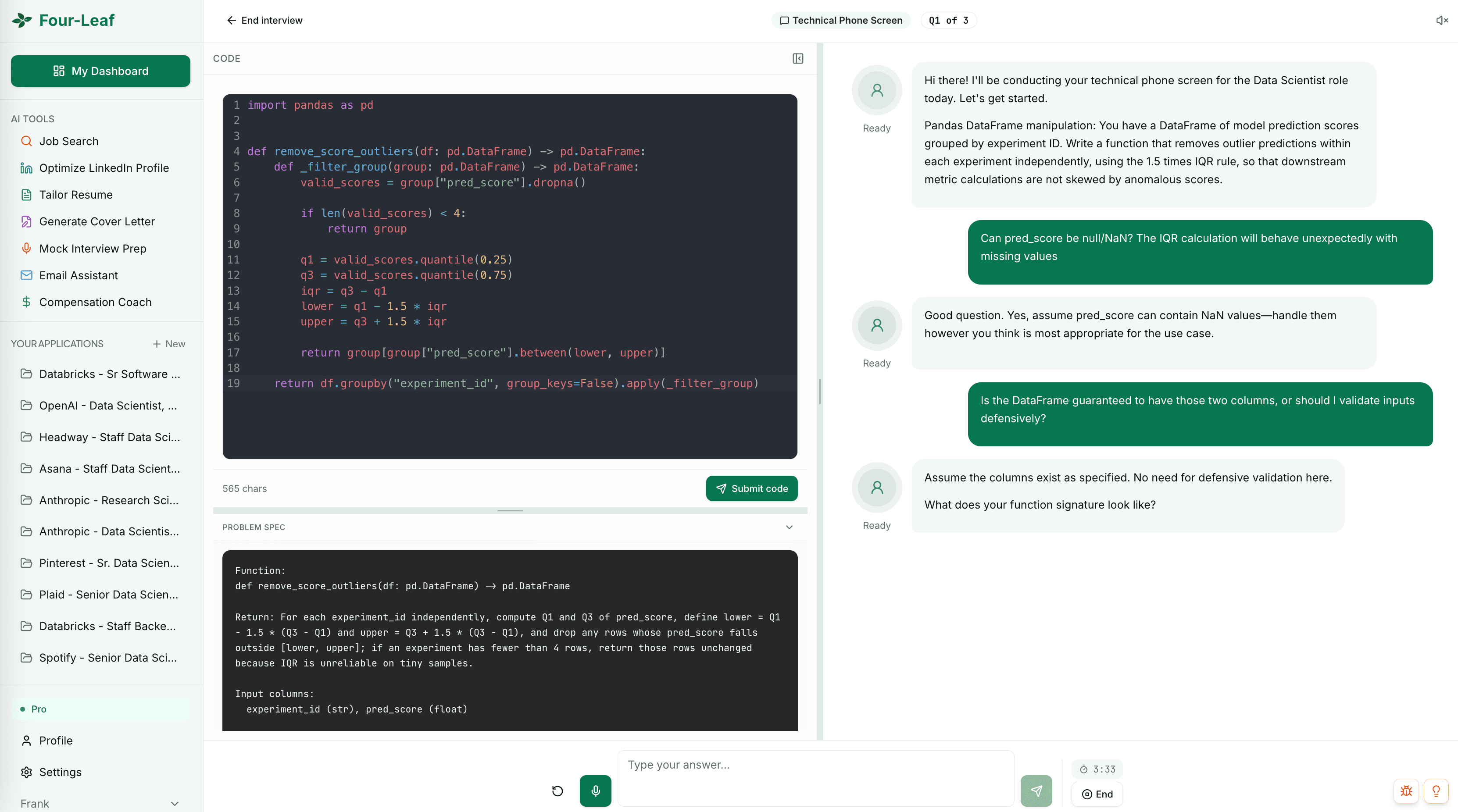 Mock interviewPractice out loud and get scored.
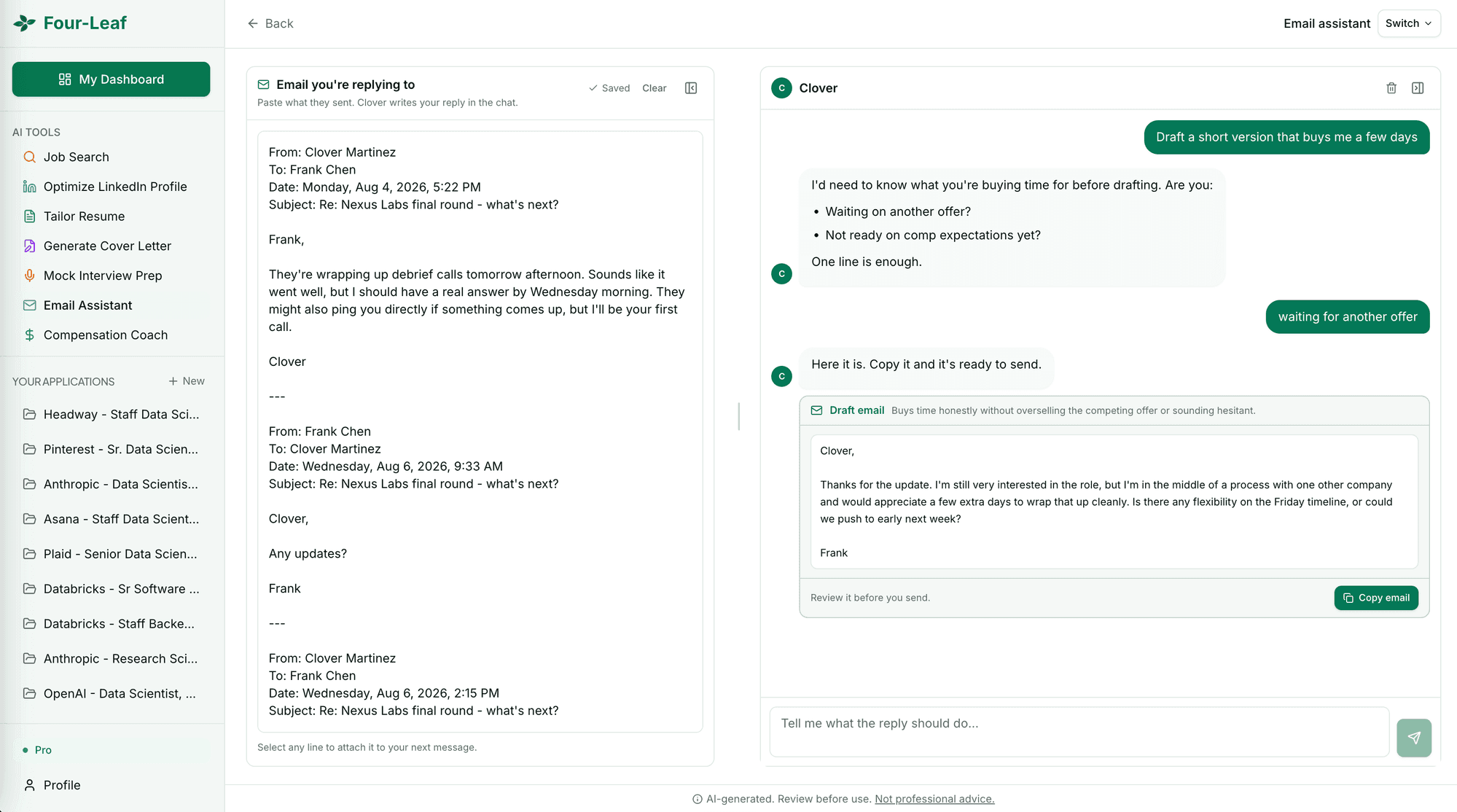 Email assistantWrite emails that get opened.
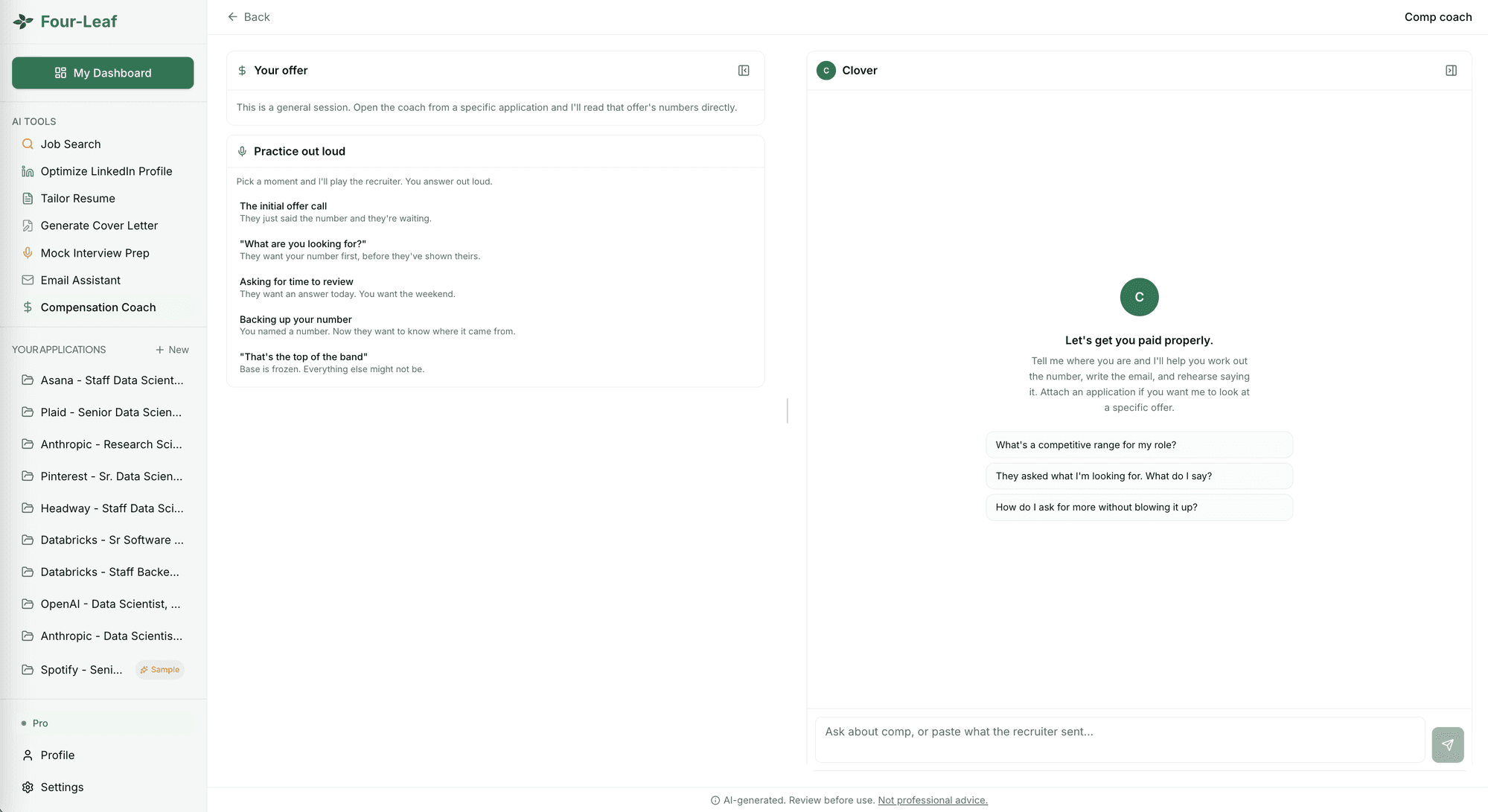 Comp coachNegotiate the offer with a calm, scripted plan.
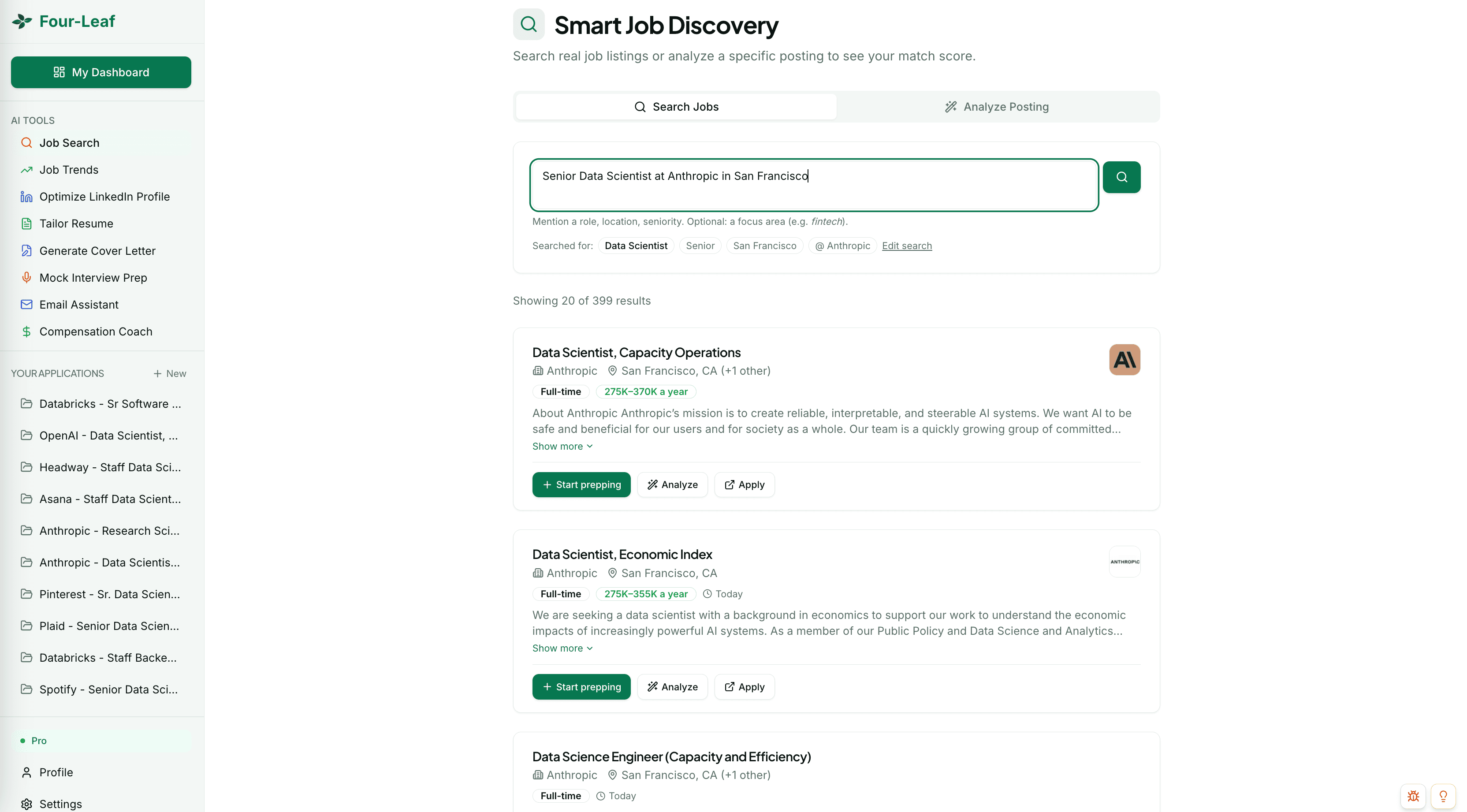 AI job searchFind the roles that actually fit.
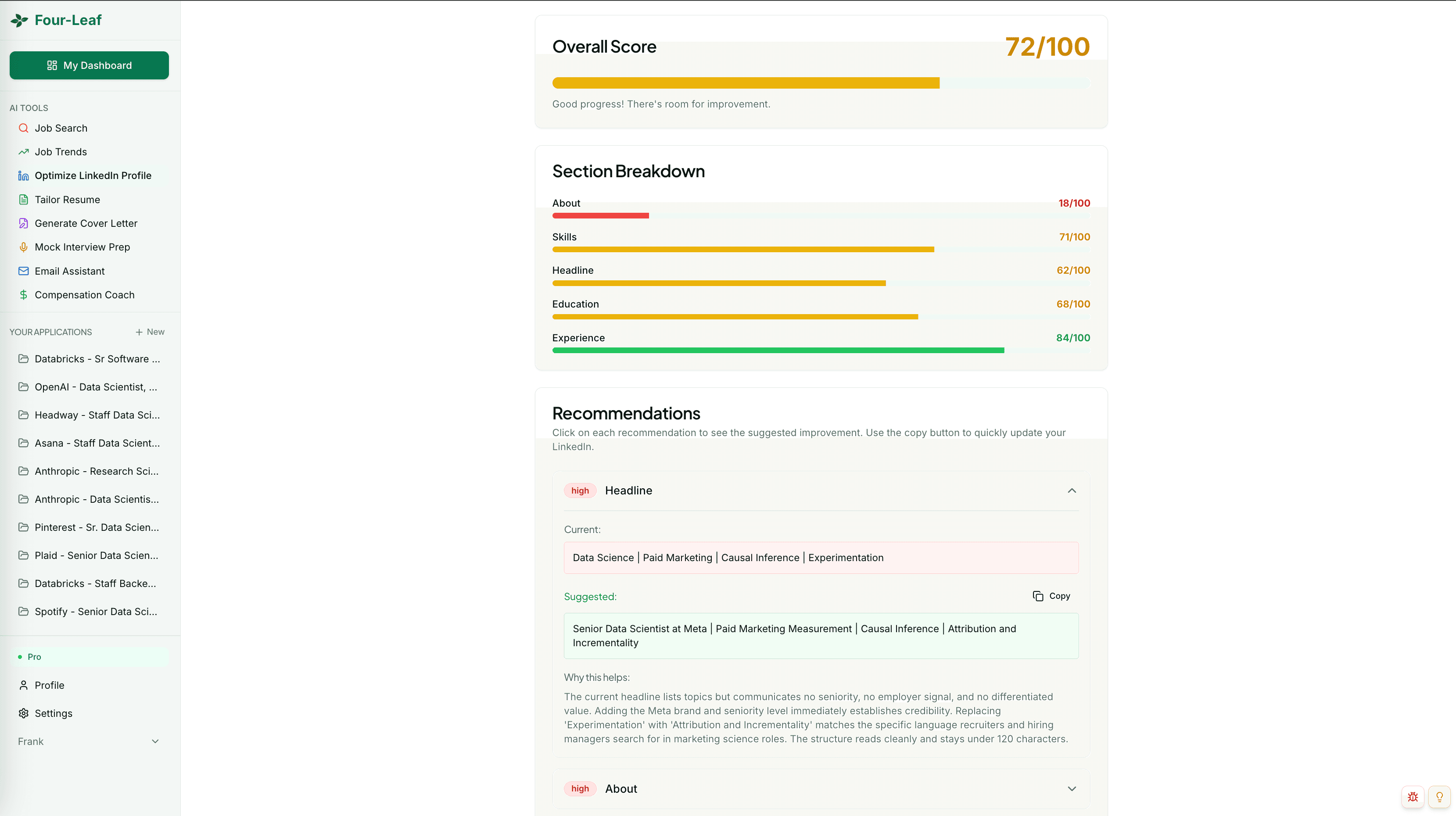 LinkedIn optimizerBuild a profile recruiters can find.
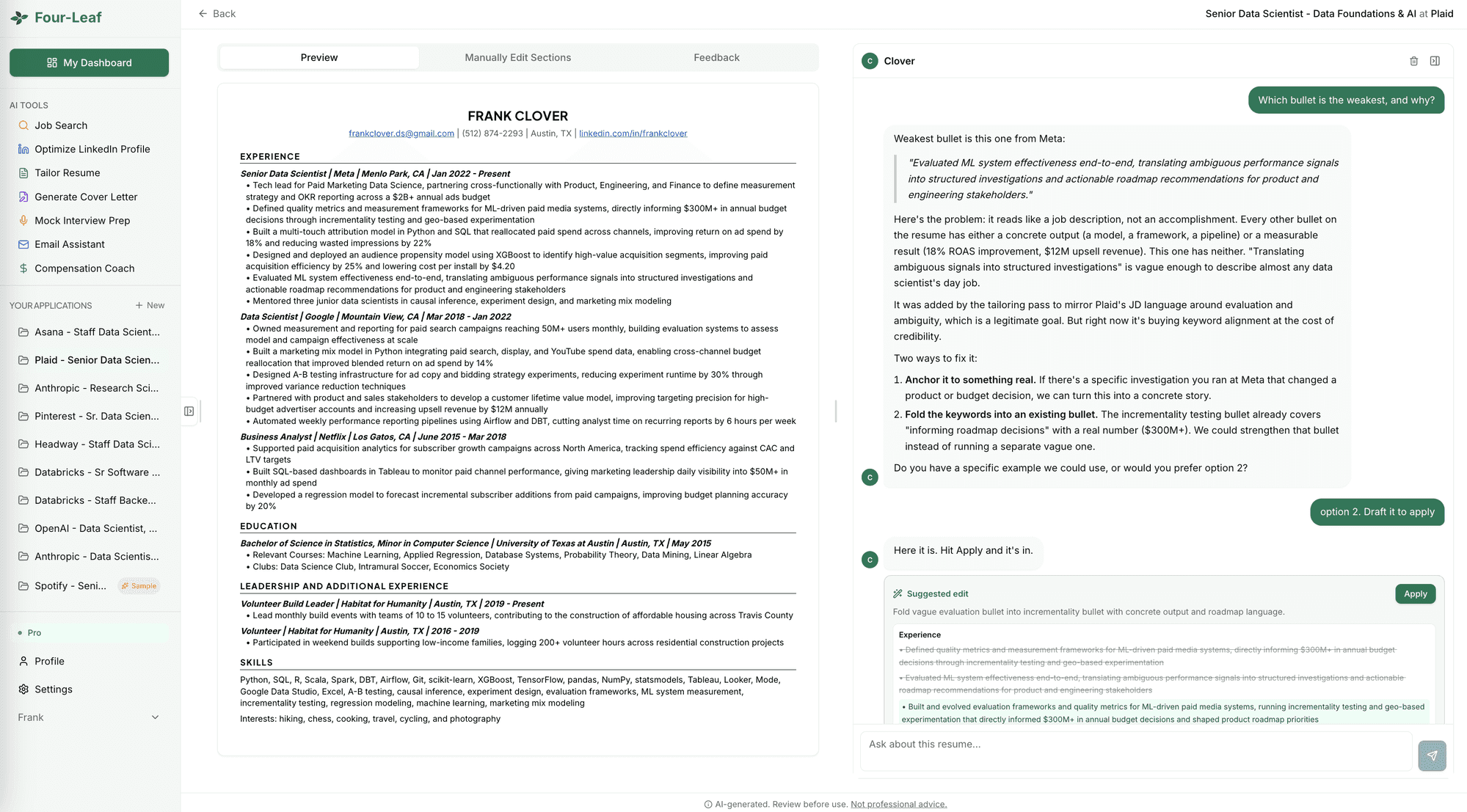 Resume tailorTailor the resume, then refine it in chat.

Start your 3-day free trial.
Every tool included. $5 for 5 days or $20 a month. No credit card required.